Social Media MarketingSocial Media Today
YouTube Hacked Channel Pause: A Brand Response Guide
The YouTube hacked channel pause blocks selected publishing tools. Understand the Studio notice, review timing and preparations for brand teams.
The YouTube creator AI survey suggests that AI already fits into many respondents' visual production routines: 72% reported using it for images or videos. The finding describes a defined group of recent video uploaders, rather than a census of professional YouTube creators.
NRG conducted the research for YouTube, surveying roughly 700 respondents between ages 14 and 44 with an online video upload during the preceding year. The results separate existing use from interest in a particular creative technique.
Social Media Today reported the findings on October 21, 2026. Its account of the Culture & Trends research identifies the 61% finding as coming from a U.S. study: respondents expressed interest in placing an AI version of themselves inside video material.
| Finding | Interpretation for a campaign brief |
|---|---|
| 72% reported AI use for visual material | The measure includes images as well as video |
| 61% expressed interest in appearing through AI | Interest does not establish completed production |
| More than two-thirds of AI-video posters had depicted themselves | This uses the narrower group that had posted AI video |
These distinctions matter when presenting the research to a client. None of these figures establishes an advertising return, a production saving or the adoption rate across every creator segment.
Examples described in the report include depicting oneself in unfamiliar occupations or historical settings, entering game scenes, and developing imagined cinematic settings. Other uses turn drawings into realistic visual concepts or help aspiring fashion designers illustrate their ideas.
For an agency, the useful question is which previously difficult idea becomes possible. A creator's personal perspective can shape a concept even when the imagery is synthetic. At the same time, the source raises concerns about deceptive portrayals and misinformation when generated people appear in clips. More output alone does not resolve those concerns or demonstrate audience value.
BestPartner recommends treating AI choices as part of the creative brief and approval process. The following steps are our advice, rather than requirements announced in the survey.
A useful approval document should let the brand see what the creator contributed and what the tool changed. That makes it easier to discuss originality and credibility before multiple versions enter production. The related discussion of Adam Mosseri on AI content reach and AI rip-offs offers another platform perspective on this distinction.
Source: Social Media Today's report on YouTube's creator AI research.
No. It describes respondents in a study of roughly 700 people aged 14 to 44 who had uploaded online video during the preceding year.
No. It measures interest in appearing inside video through AI. The finding about actual self-depiction uses the smaller group that had posted AI videos.
BestPartner recommends identifying altered scenes, assigning reviewers for likeness and product depictions, and checking whether invented imagery could be mistaken for a real experience.
To apply what you just read to your own site, start with a free audit of where things are now.
A strategist replies within one business day.
The YouTube hacked channel pause blocks selected publishing tools. Understand the Studio notice, review timing and preparations for brand teams.
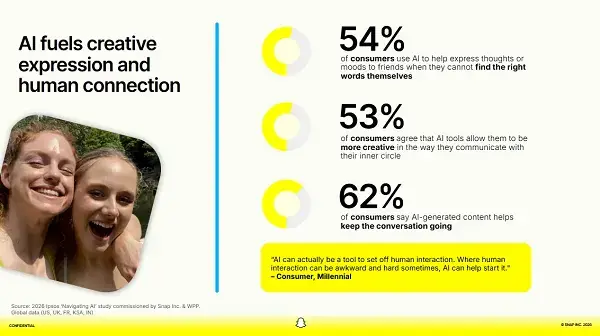
The Snapchat AI privacy report shows enthusiasm for useful assistants alongside discomfort with personalized ads. Marketers need to measure both reactions.
Meta creative targeting adds age and gender details to individual assets through the Marketing API. Learn what to check before narrowing an asset's audience.