
Social Media MarketingSocial Media Today
YouTube Hacked Channel Pause: A Brand Response Guide
The YouTube hacked channel pause blocks selected publishing tools. Understand the Studio notice, review timing and preparations for brand teams.
Meta creative targeting lets third-party advertising tools attach age and gender information to individual media assets through the Marketing API. It gives teams another way to guide asset selection, but requires care when the person buying a product is different from the person expected to use it.
Audience information can now sit with an individual image or video, rather than being defined only through an ad set. The purpose is to help Meta connect a suitable visual with a particular promotion.
Social Media Today described the addition on October 21, 2026, saying the option would become available during that week. The report concerns an API capability for third-party platforms. It does not establish that every advertiser will see an identical control in every interface.
| Decision | Unit to review | Question for the team |
|---|---|---|
| Campaign audience planning | Ad set | Who should this group of ads address? |
| New audience detail | Individual creative asset | Which age range or gender fits this media? |
| Gifting review | Purchase occasion | Could someone else buy this item for the user? |
Meta illustrated the feature with retirement-related and general savings videos intended for different age groups. It also described assigning gender information to apparel images. These examples show the mechanism; they do not establish universal audience rules for financial services or fashion campaigns.
A product-user profile may miss the buyer in a gifting situation. Applying that profile to an asset without considering the purchase occasion could reduce opportunities to show it to someone shopping for another person.
The source raised that possibility ahead of the shopping season, rather than reporting a measured loss in performance. Teams should preserve that distinction. An asset showing personal use and another presenting the same item as a gift may justify different audience decisions, even though the product itself is unchanged. This is a planning recommendation based on the reported risk.
The article also notes that Meta may already infer relevant details from product listing information. Explicit asset-level guidance therefore adds a way to state the team's intent; it is not evidence that the system previously lacked all understanding of the item. No quantified conversion improvement or cost reduction was provided.
Start with the purchase context and verify tool support before treating the option as part of a standard workflow. An agency managing several accounts should document why each asset receives a restriction or remains suitable for a broader audience.
Audience labels cannot substitute for meaningful differences between assets. For a related creative-planning discussion, see Your Ten Meta Ads Might Be One Ad. Use that review to ask whether each variation actually speaks to a distinct purchase reason.
For client reporting, separate the feature's intended benefit from observed performance. A more explicit link between an asset and its audience can be useful operationally, but a forecast of better returns still needs campaign evidence. The responsible next step is a documented test with a clear audience rationale, especially where gifting makes the buyer harder to infer from the product alone.
The report describes age ranges and gender information assigned to individual creative assets through the Marketing API.
No. The source describes a capability for third-party platforms using the API. Teams need to verify support in their own tools and accounts.
The report provides no quantified performance guarantee. Check results and consider whether audience choices exclude people purchasing gifts for others.
To apply what you just read to your own site, start with a free audit of where things are now.
A strategist replies within one business day.
The YouTube hacked channel pause blocks selected publishing tools. Understand the Studio notice, review timing and preparations for brand teams.
The YouTube creator AI survey reports 72% usage among respondents. Learn what the sample covers and how to brief brand partners.
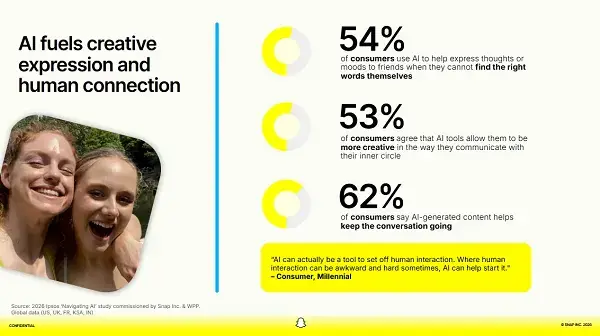
The Snapchat AI privacy report shows enthusiasm for useful assistants alongside discomfort with personalized ads. Marketers need to measure both reactions.