Social Media MarketingSocial Media Today
YouTube Hacked Channel Pause: A Brand Response Guide
The YouTube hacked channel pause blocks selected publishing tools. Understand the Studio notice, review timing and preparations for brand teams.
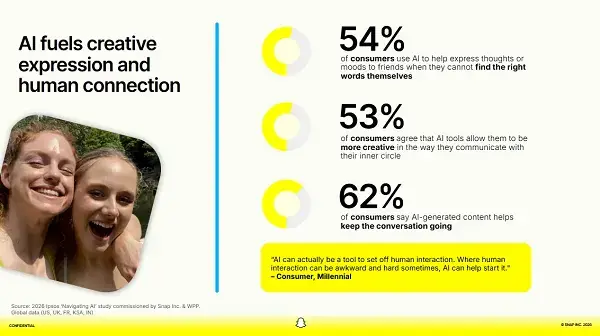
The Snapchat AI privacy report suggests that willingness to share information with a helpful assistant does not automatically extend to personalized advertising. For marketers, the useful distinction is between the value of an AI interaction and the response to how personal information appears in an ad experience.
The report argues that some people accept data sharing when an AI experience delivers a clear, immediate benefit. Its advertising findings also show limits to that acceptance, so adoption should not be treated as blanket approval of other data uses.
Social Media Today covered the findings on October 22, 2026. Snapchat's report draws on an Ipsos and WPP survey involving more than 4,200 people who use AI. That scope matters: the findings should not be presented as a direct measurement of attitudes across everyone, including people who do not use these tools.
| Finding described in the coverage | Reported share | What it measures |
|---|---|---|
| AI helps people keep a conversation going | 62% of AI users | Perceived conversational benefit |
| Highly personalized AI ads using personal information feel intrusive | 70% of consumers | Discomfort with advertising |
| Entirely AI-made content feels lacking in human character | 56% of consumers | Perception of the output |
The consumer labels follow the source's wording. The supplied coverage does not give enough detail to reconstruct every subgroup or the complete survey methodology.
A private tool that helps someone express a difficult thought offers a different experience from an advertisement reflecting their personal information. The results support evaluating those contexts separately rather than assigning users one overall attitude toward AI.
More than 80% characterized AI positively as an approachable, cooperative presence. Another finding, at 74%, concerned the opportunity to rehearse difficult feelings without fear of judgment before speaking to other people. Those responses describe help with expression and relationships. They do not establish enthusiasm for every commercial use of an interaction.
The coverage also notes remaining caution about relying on AI for financial management or purchases. Product recommendations may be part of the decision process, but that does not demonstrate unrestricted confidence in delegating a transaction.
There is a further measurement limit: the article does not establish whether the same individuals gave both the positive assistant responses and the negative advertising responses. These figures can illustrate a tension across the report without proving a particular person's behavior.
Design around a specific benefit and test the advertising experience separately. This is an interpretation for planning, rather than a claim that the study tested a particular brand workflow.
For another content-distribution context, see Snapchat Stops Recommending AI Slop. A tool's usefulness, the perceived character of its output and the acceptability of an ad are distinct questions for a marketing team to investigate.
A client brief should therefore state the audience covered by the survey, the benefit being proposed and the response that still needs testing. The report gives a reason to examine the value exchange carefully; it does not prove that users will welcome a campaign simply because AI is part of their routine.
The report is based on an Ipsos and WPP survey of more than 4,200 AI users, as described by Social Media Today.
No. Positive responses about conversational help coexist with discomfort about advertising that uses personal information. The experiences should be evaluated separately.
The supplied article does not provide respondent-level overlap. It shows contrasting findings without establishing that the same people gave both answers.
To apply what you just read to your own site, start with a free audit of where things are now.
A strategist replies within one business day.
The YouTube hacked channel pause blocks selected publishing tools. Understand the Studio notice, review timing and preparations for brand teams.
The YouTube creator AI survey reports 72% usage among respondents. Learn what the sample covers and how to brief brand partners.
Meta creative targeting adds age and gender details to individual assets through the Marketing API. Learn what to check before narrowing an asset's audience.