
Tech & AISocial Media Today
AI Operational Risks: Lessons From Meta and Grok
Meta and Grok failures expose risks in automated account protection, chatbot instructions and sensitive claims. Here is what brand teams should review.
Publicis Marcel, the internal AI platform Publicis Groupe launched in 2017, now has its own CEO and chief strategy officer and will be run more like a standalone business. The move signals that agentic AI, meaning AI agents that complete multistep tasks on their own, sits at the center of the holding company's growth plans (Marketing Dive, as of October 26, 2026).
Scott Hagedorn becomes CEO of Marcel and Sam Levine Archer becomes chief strategy officer. Both came to Publicis from rival Omnicom, where they helped run the media division, and have led AI solutions work at Publicis for the past four years.
| Growth area | Group assets Marcel draws on |
|---|---|
| Influencer and creator marketing | Publicis Sapient (technology and consulting) |
| Sports and culture marketing | Epsilon (customer data) |
| Optimizing for AI chatbot answers | Lotame (consumer profiles) |
| Data connectivity | LiveRamp, a $2.2 billion acquisition being finalized |
When it bought Lotame, Publicis said it gained a view into nearly 4 billion consumer profiles, about 91% of internet-connected consumers worldwide. Marcel is meant to connect that data into AI agents built for clients.
Marcel was widely mocked when it was unveiled, but it now looks like an early bet on AI's role in marketing. Publicis reported 5% organic net revenue growth in the third quarter of 2026, ahead of most peers. CEO Arthur Sadoun said that while competitors cut headcount and investment, Publicis is doing the opposite: strengthening teams and doubling down on data and technology.
Demand is uneven, though. Agentic services are busy, while large enterprise-wide AI transformations are slower because they are costly and time-intensive. The Sapient-led technology unit remained sluggish in Q3.
Independent agencies like ours face the same question from clients. Our answer is to start with small automations tied directly to client data and prove them with results.
Source: Marketing Dive
An internal AI platform Publicis Groupe introduced in 2017 to connect its agencies and build AI agents for clients.
Scott Hagedorn as CEO and Sam Levine Archer as chief strategy officer, both former Omnicom executives.
Publicis reported 5% organic net revenue growth in Q3 2026.
About $2.2 billion, in a deal that is being finalized.
To apply what you just read to your own site, start with a free audit of where things are now.
A strategist replies within one business day.
Meta and Grok failures expose risks in automated account protection, chatbot instructions and sensitive claims. Here is what brand teams should review.
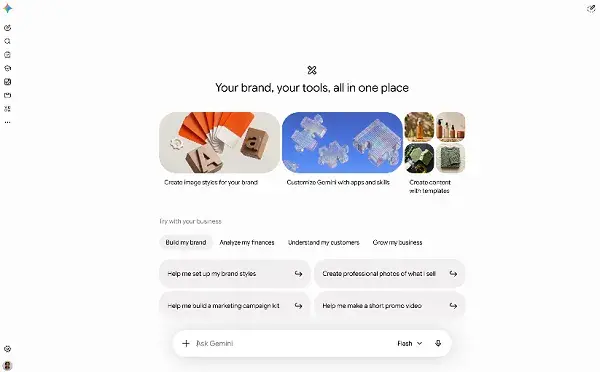
Google added brand management tools to Gemini for business. Upload brand images, fonts and colors once to generate consistent creative with Nano Banana 2.1, connect Adobe, Canva, Dropbox and Shopify, and turn receipts into charts.

Buzzvil's BD strategy team has zero developers but runs 32 AI workflow automations — from 7-minute revenue drop analysis to 90% fewer manual steps. How they scaled from personal hacks to team systems.