
MarketingMarketing Dive
Algorithmic Pricing: Questions for US Advertising Teams
Algorithmic pricing can connect audience data, offers and advertising claims. Separate the concepts and identify what needs jurisdiction-specific review.
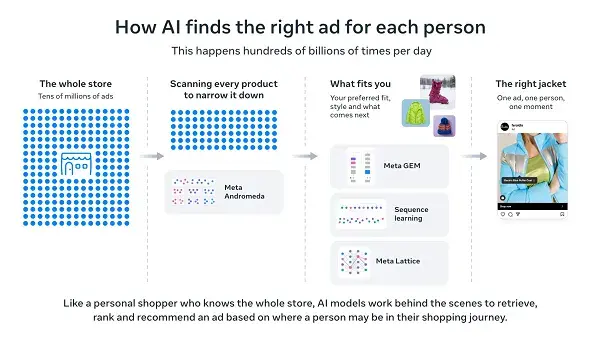
Meta ad AI improvements are producing higher click and conversion figures in company announcements, but those figures cover different periods and systems. Advertisers need to separate those claims before translating them into account targets or decisions about spend.
As of October 29, 2026, Marketing Dive reports that Meta attributed an 8.3% increase in Facebook ad clicks and a 15.7% increase in conversions during the second quarter of 2026 to improvements in its ad ranking system. The report cites a Meta announcement issued on October 28. These are company-reported effects, not a forecast for every advertiser.
The article also describes a 1.4% Facebook conversion increase linked to third-quarter improvements in Andromeda. Separately, generative retrieval introduced in Facebook Feed produced a nearly 2% conversion increase across targeted segments, according to Meta. Different periods and scopes make these unsuitable for addition into a single performance promise.
Meta says Andromeda can consider a broader selection of potential product matches at an early stage of ad delivery. Its Generative Ads Recommendation Model, or GEM, can assess more engagement signals. GenRecs aims to connect user preferences with relevant promotions, including new ads that have little engagement history.
| Reported area | Interpretation boundary |
|---|---|
| Second-quarter ranking gains | Meta's stated Facebook ranking-system effect |
| Third-quarter Andromeda gain | A separate model improvement and reporting period |
| Feed generative retrieval | A result described for targeted segments |
The common theme is greater capacity to find candidates and assess relevance. That does not remove the need for an advertiser to define a worthwhile outcome. A platform-recorded conversion may not mean the same thing as a fulfilled order or a qualified lead in the advertiser's business records.
Treat the announcement as a reason to evaluate delivery quality, rather than a reason to assume a cheaper acquisition cost. First check that purchase and lead events are consistent and not duplicated. Then compare platform results with order or sales records over a suitable business cycle. Where available, include cancellations, returns and qualification outcomes in the interpretation.
Creative inputs remain a practical responsibility. Give the system meaningful choices about the product's use, the reason to buy and the concern a customer needs answered. Cosmetic variants alone may not test those different propositions. Record the changes made during a test so that improved results are not automatically credited to a model upgrade.
These are recommendations based on the announcement, not performance findings from our own experiment. A controlled comparison with a stable business objective can help establish whether the advertiser's account benefits. Budget decisions should follow evidence from that account, with the reporting period and conversion definition kept visible.
For support connecting paid media with business outcomes, see our Marketing services.
Source: Marketing Dive on Meta's expanding advertising processing capacity, as of October 29, 2026.
No. It is Meta's reported second-quarter Facebook ranking-system effect, not an account-level guarantee.
No. They describe different periods, changes and scopes.
Verify event quality and compare platform conversions with business records and costs.
To apply what you just read to your own site, start with a free audit of where things are now.
A strategist replies within one business day.
Algorithmic pricing can connect audience data, offers and advertising claims. Separate the concepts and identify what needs jurisdiction-specific review.

Disney TikTok Shop brings licensed brands, early-access gifts and creator content into one holiday event. Here is what retail marketers can learn.
Google AI search ads are expanding while revenue growth slows. Learn which platform figures matter and what advertisers should verify themselves.