
Marketing모비인사이드
Startup Document Strategy: One Source, Three Documents
Build investor decks, company profiles and proposals from shared facts. Keep metric definitions consistent and review changes each quarter.
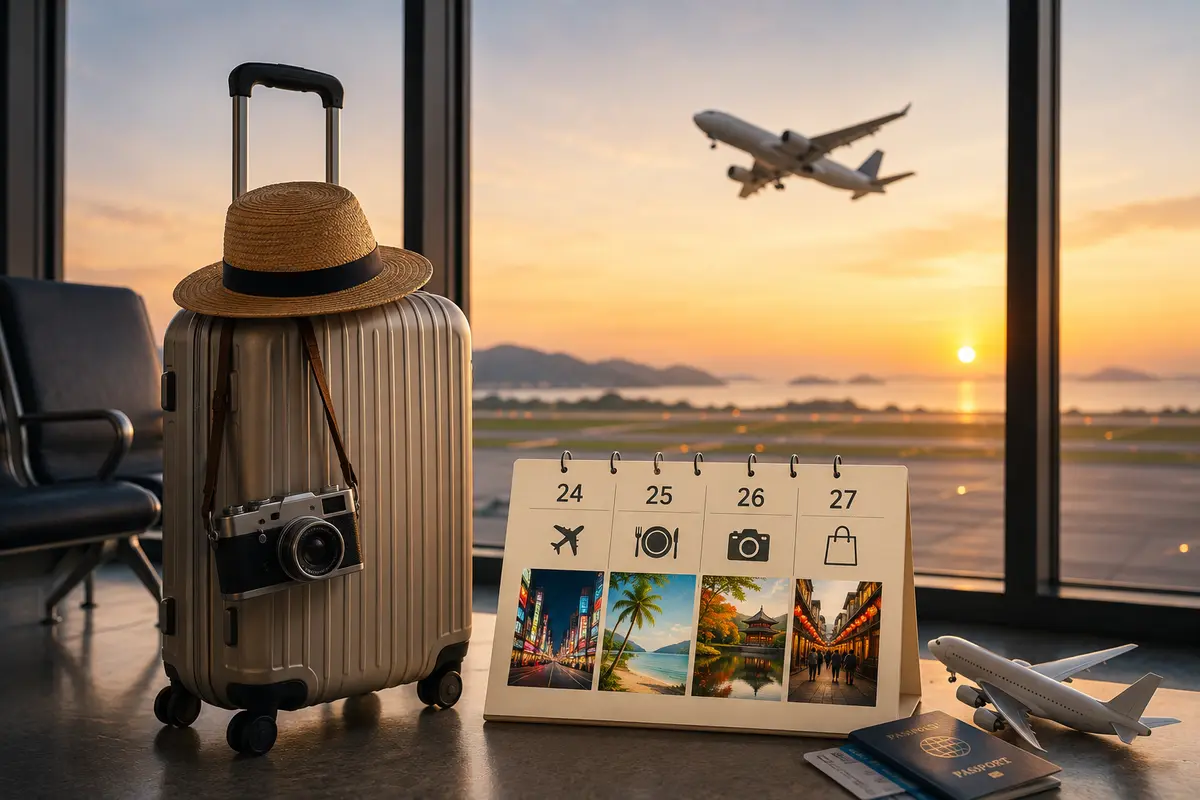
Korea's 2026 Chuseok holiday — the country's biggest fall break — runs just four days, September 24–27. Yet outbound flight searches for the surrounding window (departures September 13–October 3) surged 92.4% year over year. Hot demand squeezed into a short window has redrawn the market, according to an analysis by Korean marketing outlet Mobiinside: the first question travelers ask has shifted from "where is good?" to "what fits in four days?"
Each major Korean travel agency reported a different top destination, a useful reminder not to read a market off a single vendor's chart. Kyowon Tour's TravelEasy put Japan (32.8%) and China (25.4%) on top; Hanatour reported a short-haul top three of Japan (23%), Vietnam (20.3%), and China (18%); Interpark Tour said short-haul routes took roughly 80% of bookings. But three signals held across every dataset.
First, short-haul convergence: routes within two to five hours dominated every ranking, because on a four-day break, travel time is stay time. Second, a clear China rebound — from 10% last year to 18% at Hanatour, and second place at 25.4% for Kyowon — helped along by visa-free entry policies. Third, a north-over-south split within Europe (Northern Europe 8.8% > Western 7.2% > Southern 4.5% at Kyowon), confirming in booking data the "coolcation" pattern of travelers dodging extreme summer heat.
Seller messaging has split into two playbooks. For short-haul, the product is time density: direct, late-night, and early-departure flights that maximize stay time, plus instant confirmation and transparent pricing — because on a short break, certainty is what converts. Promotions from NOL (accommodation coupon packs) and Webtour (segmented deals for Jeju, domestic, and flights) fit this mold.
Long-haul flips the logic. Europe and similar destinations have been redefined as a premium niche for travelers willing to attach annual leave — and the content that converts is "leave-day math": show visually that adding two days of leave turns the break into a nine-day trip. In between, Southeast Asia and mid-haul routes are the defensive zone, where pricing, package construction, and refund flexibility decide whether wavering bookers stay.
The most notable move: sellers are treating Chuseok not as an endpoint but as the opening of a second early-fall peak. Late-August campaign creative consistently bundles Chuseok with Korea's long October holiday weekend, and agencies like NOL, ModeTour, and Webtour are running both under one campaign umbrella — converting Chuseok's short-haul travelers into October rebookings. Sellers who widen the lens from four days to a two-month season capture both basket size and repeat bookings.
The underlying principle isn't travel-specific: when a consumer constraint (here, time) becomes the deciding factor, the brands that win are the ones that rearrange their offer around that constraint. Selling "what fits in four days" instead of "where to go" is structurally the same move as Daiso selling decision-free convenience rather than cheap goods — a case we unpacked in Daiso Didn't Sell Cheap Goods — It Sold Five Minutes Without a Decision. Whatever your category, define your customer's scarcest resource — money, time, or decision energy — and rebuild the offer around that budget.
Chuseok is Korea's fall harvest holiday and one of its two biggest travel seasons. In 2026 it runs only four days (September 24–27), which compressed travel choices and reshaped how travel brands package and message their offers.
No — outbound flight searches rose 92.4% year over year. The constraint changed where demand went, not how much there was: bookings converged on short-haul destinations where travel time doesn't consume the stay.
Identify your customer's scarcest resource — time, money, or decision energy — and rearrange your product and messaging around that budget. Constraint-based selling converts better than catalog-style curation when consumers are squeezed.
To apply what you just read to your own site, start with a free audit of where things are now.
A strategist replies within one business day.
Build investor decks, company profiles and proposals from shared facts. Keep metric definitions consistent and review changes each quarter.

Roblox movie marketing brings The Cat in the Hat into three established games. Explore Warner Bros.' launch timing, rewards and agency takeaways.

The Target holiday campaign links a fictional gift academy with stores, video and creator programs, offering a useful structure for seasonal planning.