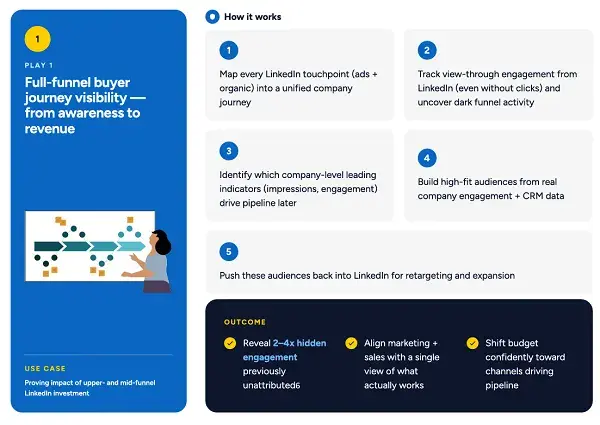
LinkedIn has published an 18-page B2B ads attribution guide designed to connect early buyer engagement signals with ad strategy and help marketers make smarter investment decisions. The context: only 33% of B2B marketers strongly agree they can prove marketing’s impact to their C-suite, and 75% say their measurement systems fall short, per LinkedIn.
Why B2B attribution is so hard
As LinkedIn puts it, B2B buying is “lengthy, nonlinear, and involves multiple stakeholders interacting across dozens of touchpoints.” Buyers switch channels, engage anonymously, consume content without clicking and increasingly use AI tools to inform decisions. By the time an opportunity hits the pipeline, much of what shaped the decision happened outside traditional measurement.
The result is misattribution — and missed opportunities to invest in what actually works.
What the guide covers
- Five measurement frameworks, each broken down into practical steps
- Full-funnel visibility, including signals before the click
- A list of LinkedIn-approved attribution and analytics partners
The guide doubles as a promotional vehicle for LinkedIn’s own analytics tools, some of which are only available to paying users.
How to apply it
- Stop judging B2B performance on last click. Overlay accounts exposed to ads with accounts entering the pipeline to see account-level influence.
- Change the language of C-suite reporting. Replace CTR and CPL with revenue-linked metrics: how many target accounts became opportunities, and how win rates differ for ad-exposed accounts.
- Treat no-click consumption as signal. Video views, document opens and creator content engagement all indicate intent. See why B2B creator marketing is the next wave.
- Build cross-channel measurement. Measuring LinkedIn well isn’t enough on its own — Kantar’s 2026 Media Reactions shows how few advertisers trust their media mix.